Facebook Ads vs Google Ads: Which is Best for Your Business?
November 10, 2025
Introduction
In the ever-evolving landscape of digital advertising, understanding the distinctions between Facebook Ads and Google Ads is crucial for businesses seeking to maximize their marketing efforts. Both platforms command significant attention and offer robust tools for targeting potential customers, yet they operate on fundamentally different principles. Facebook Ads harness the power of social engagement, allowing brands to connect with users based on interests, demographics, and behavioral patterns. This visually-driven approach captures users' attention while they engage with friends and content, often leading to community building and brand loyalty.
Conversely, Google Ads capitalizes on user intent. By presenting advertisements within Google’s search results, businesses can reach individuals actively seeking specific products or services, which enhances the likelihood of immediate conversions. This intent-focused strategy allows for precision targeting based on search queries, making it particularly effective for businesses looking to drive sales or inquiries at critical moments in the user journey.
By thoroughly understanding these two platforms, marketers can tailor their strategies to align with their specific goals. Whether focusing on brand awareness through Facebook’s engaging ads or capturing real-time demand through Google’s targeted search ads, recognizing the unique benefits of each can significantly enhance advertising outcomes. This article delves deeper into the functionalities, advantages, and best practices of both platforms, enabling marketers to make informed decisions that drive successful campaigns and optimize return on investment (ROI).
And I want you to stick with me until the end, because I’m giving you a free resource called Perfect Ad Platform Selection that makes this decision incredibly easy. Once you have it, you’ll never feel confused about ads again.
Understanding Facebook Ads vs Google Ads
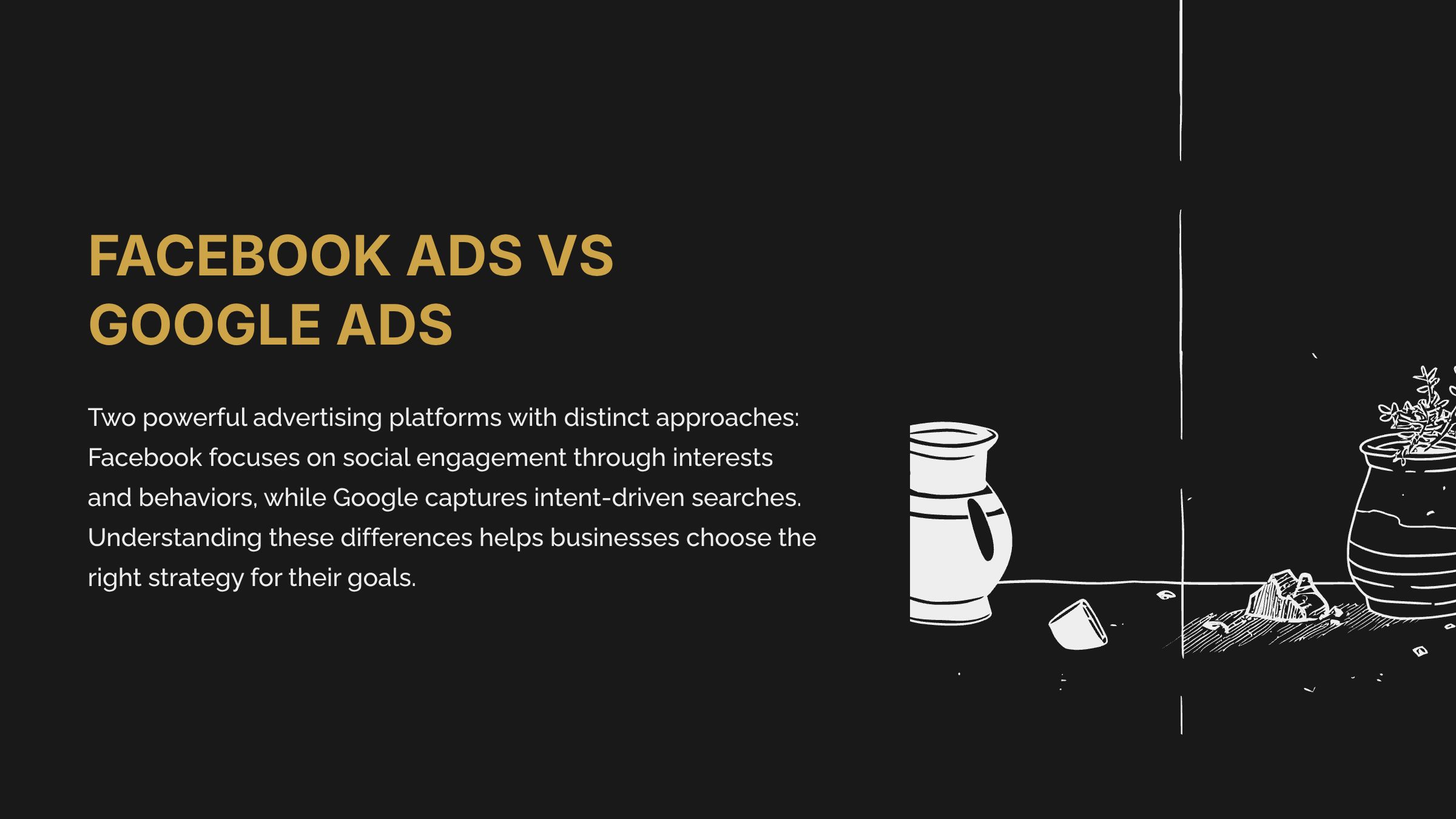
Facebook Ads and Google Ads are two of the most prominent digital advertising platforms available today, each offering unique capabilities and approaches to targeting users. Facebook Ads primarily focus on social networking, allowing businesses to engage with audiences based on interests, behaviors, and demographic data. Users encounter these ads while scrolling through their social feeds, making it a more visual and interactive experience. In contrast, Google Ads operates mainly through search intent, displaying advertisements based on users' queries within Google’s search engine. This intent-driven model means that ads are shown to users actively searching for specific information or products, increasing the likelihood of immediate engagement.
Understanding these fundamental differences in user targeting and ad display helps businesses choose the right platform for their marketing strategies. Facebook caters effectively to awareness and community engagement, ideal for brands looking to build a loyal following. Meanwhile, Google Ads is optimal for capturing demand at the moment consumers are thinking about making a purchase. By recognizing these distinctions, marketers can align their advertising efforts with their business objectives, optimizing both visibility and effectiveness within their targeted audience segments. As a result, they can implement more informed decisions to maximize their advertising ROI and overall marketing success.
Audience Targeting Capabilities
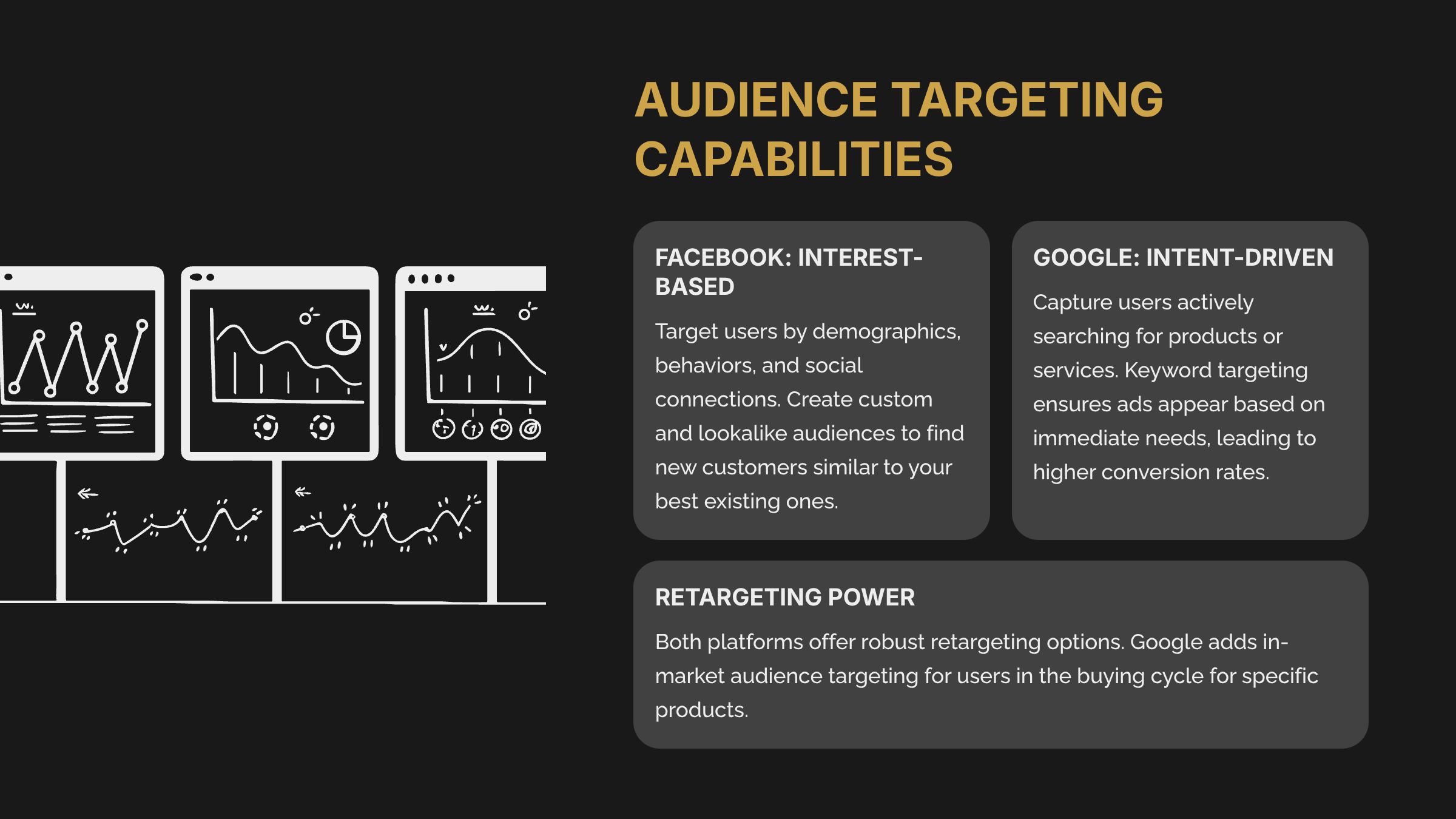
Facebook Ads and Google Ads offer distinct audience targeting mechanisms that enable businesses to reach their ideal customers effectively. Facebook Ads focuses primarily on demographic and interest-based targeting. Advertisers can create custom audiences based on user behaviors, interests, and social connections, allowing for personalized ad experiences. Advanced features, such as lookalike audiences, empower marketers to find new users similar to their best existing customers, enhancing campaign reach.
Conversely, Google Ads emphasizes intent-driven targeting through search queries. This platform excels in capturing users actively seeking information or products, making it highly effective for capturing high-intent traffic. Advertisers can utilize keyword targeting to bid on specific search terms, ensuring ads appear to users based on their immediate needs, which can lead to higher conversion rates.
Both platforms provide robust options for retargeting, enabling businesses to reconnect with users who previously interacted with their brand. Additionally, Google Ads allows in-market audience targeting, presenting ads to users who are in the buying cycle for specific products or services.
In summary, the key difference lies in the approach: Facebook Ads excels in reaching users based on demographics and interests, while Google Ads targets users based on search intent. Understanding these nuances is crucial for businesses aiming to craft effective marketing strategies on each platform. By leveraging the right targeting capabilities, advertisers can maximize the effectiveness of their campaigns and achieve better ROI.
Cost and Budget Considerations
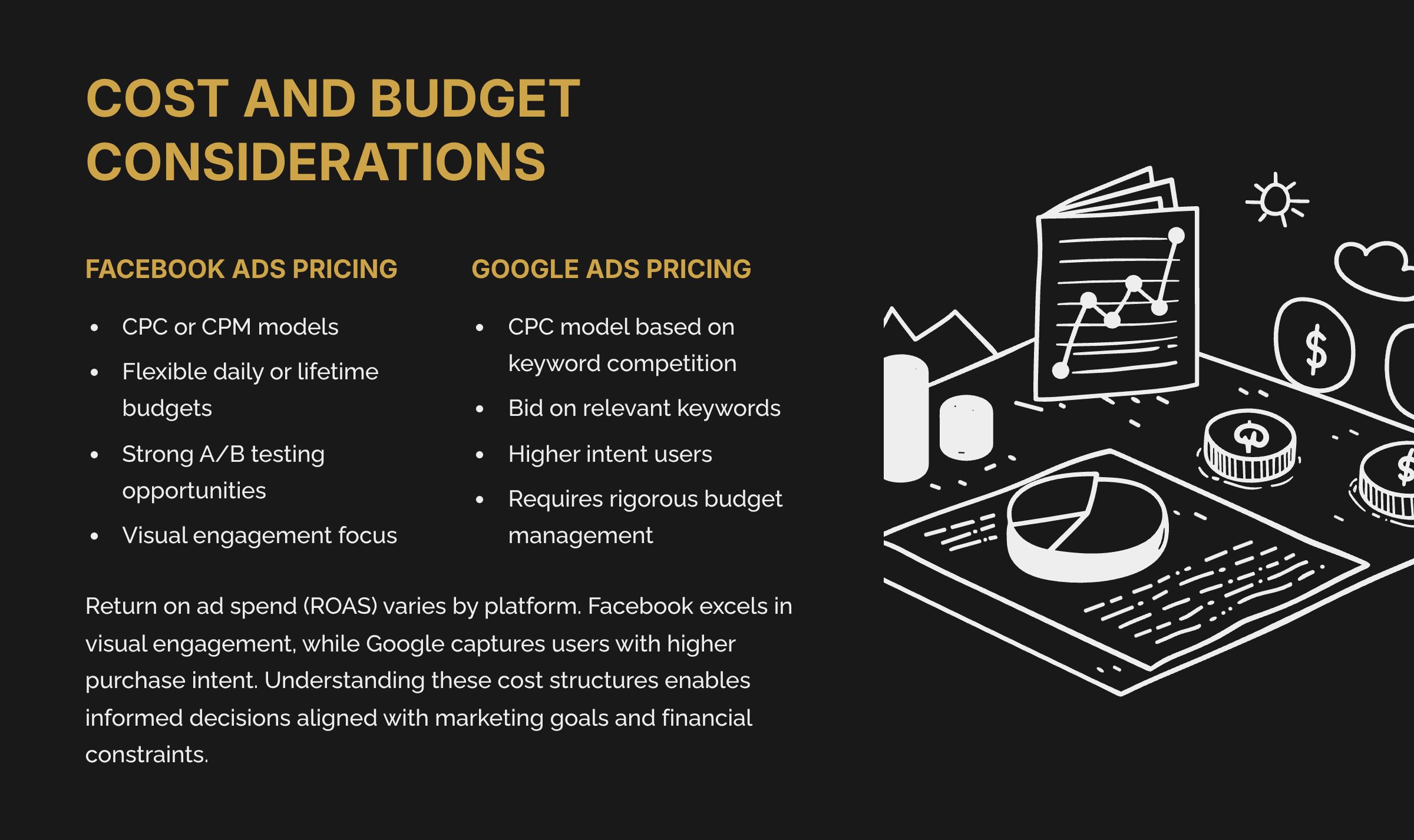
When evaluating advertising strategies, understanding the cost structures associated with Facebook Ads and Google Ads is essential for effective budgeting. Facebook Ads typically operate on a cost-per-click (CPC) or cost-per-impression (CPM) basis, allowing advertisers to set daily or lifetime budgets. This flexibility can be advantageous for businesses with varying budget constraints. On the other hand, Google Ads predominantly utilizes a CPC model influenced by keyword competitiveness and search volume. Advertisers bid on keywords relevant to their audience, impacting their costs and overall spend.
Return on ad spend (ROAS) is a critical metric for both platforms. While Facebook Ads provide a robust visual engagement through its targeting capabilities, Google Ads often exhibits higher intent, as users are actively searching for specific products or services. This distinction can affect the overall effectiveness of ad spend.
Furthermore, businesses need to consider their ability to optimize and manage budgets across campaigns dynamically. Facebook Ads often present opportunities for A/B testing different creatives and audience segments, helping to refine ad performance without necessitating a large budget. Conversely, Google Ads may require more rigorous management of budget allocation across multiple campaigns and keywords.
In summary, understanding the cost implications and flexibility of budgets on Facebook Ads and Google Ads enables advertisers to make informed decisions that align with their overall marketing goals and financial constraints.
Ad Formats and Creative Options
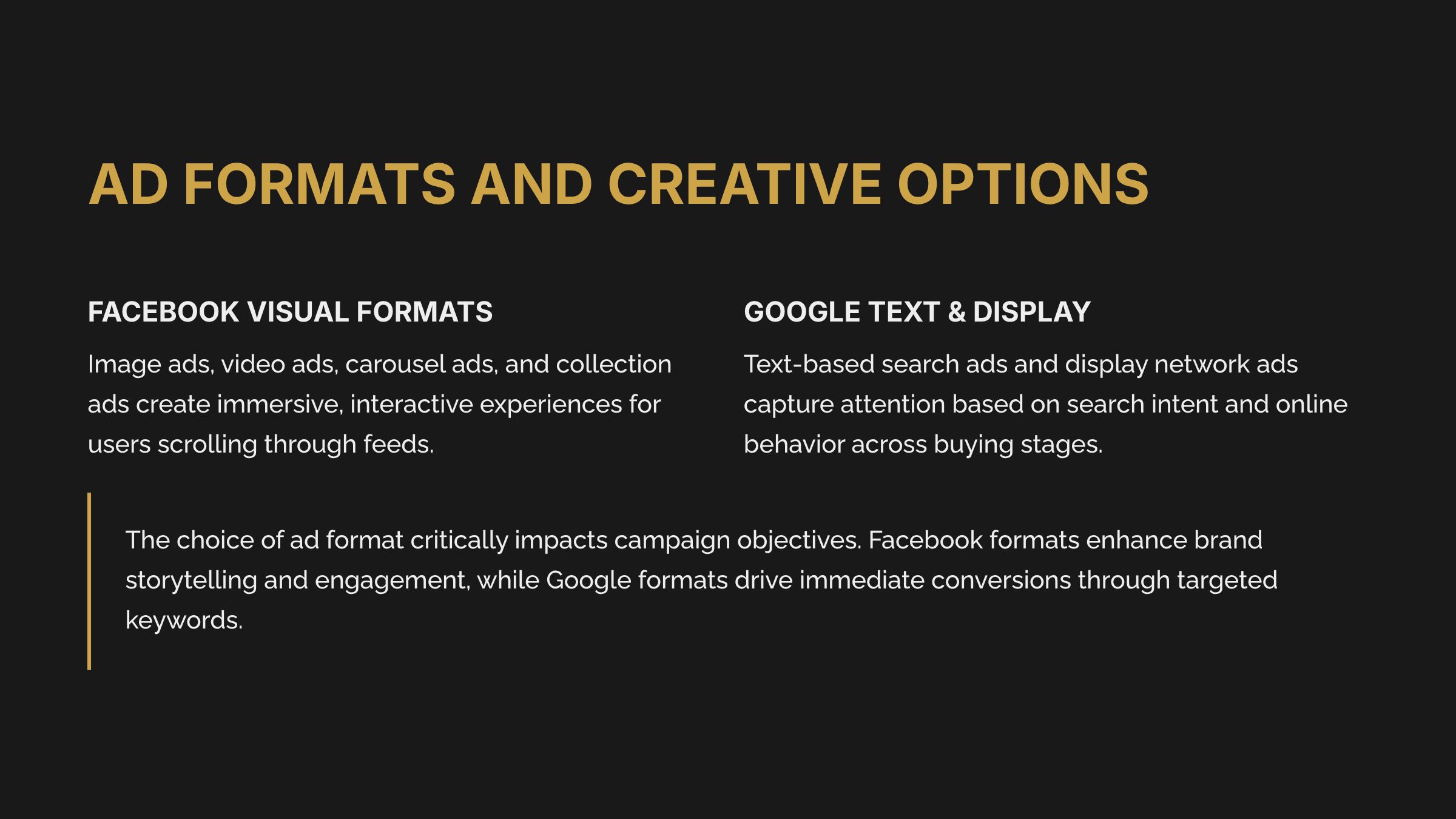
Businesses utilizing Facebook Ads and Google Ads benefit from diverse ad formats that can significantly influence user engagement and overall campaign effectiveness. Facebook Ads offers visually appealing formats such as image ads, video ads, carousel ads, and collection ads, allowing brands to showcase their products and narratives creatively. These formats are designed to engage users scrolling through their feeds, making experiences interactive and immersive.
In contrast, Google Ads primarily relies on text-based search ads and display ads that appear across the Google Display Network. Display ads include a mix of image, video, and responsive ads, which are utilized strategically to capture user attention based on their search intent and online behavior. This dual approach aids businesses in reaching audiences at various stages of the buying journey.
The choice of ad format can critically impact campaign objectives. For instance, visually compelling Facebook formats can enhance brand storytelling and foster engagement, while the informative, search-oriented Google Ads formats can drive immediate conversions through targeted keywords. Understanding these differences is essential for marketers to align their creative strategies with their advertising goals. By leveraging the unique strengths of each platform's ad formats, businesses can enhance their visibility, drive user engagement, and ultimately achieve better results in their advertising endeavors.
Campaign Goals and Business Objectives
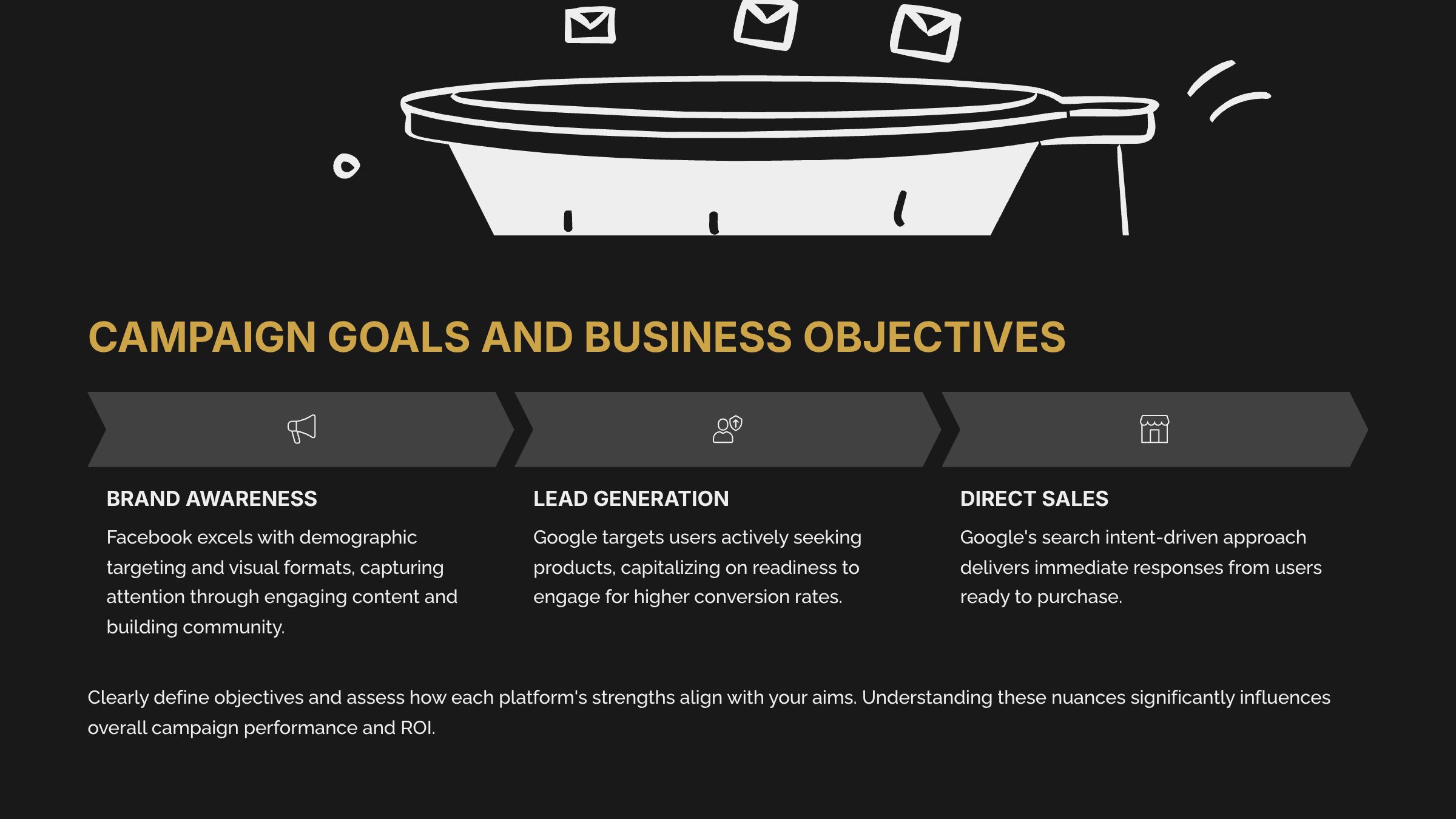
Understanding how different business objectives align with advertising platforms is crucial for effective marketing strategies. Facebook Ads and Google Ads serve distinct purposes based on campaign goals, which include brand awareness, lead generation, and sales conversions.
For businesses focusing on brand awareness, Facebook Ads may be more suitable due to its extensive demographic targeting and visual ad formats. The platform excels in capturing attention through engaging content, making it ideal for fostering brand recognition and building a community around products.
On the other hand, Google Ads is advantageous for lead generation and direct sales. With its search intent-driven approach, Google Ads targets users actively seeking products or services, potentially leading to higher conversion rates. Businesses aiming for immediate responses often find Google Ads to be a more effective investment, capitalizing on the users’ readiness to engage.
In selecting the appropriate platform, it's essential for marketers to clearly define their objectives and assess how each platform's strengths align with these aims. Recognizing the nuances between Facebook's social engagement capabilities and Google’s search-focused approach can significantly influence overall campaign performance.
Ultimately, understanding how campaign goals translate into platform choice enables businesses to tailor their advertising strategies for maximum effectiveness, optimizing for either brand growth or immediate sales and lead generation.
Performance Tracking and Analytics Tools
Both Facebook Ads and Google Ads offer robust performance tracking and analytics tools, essential for marketers aiming to optimize their advertising strategies. Facebook's Ads Manager provides comprehensive metrics that allow businesses to monitor engagement rates, impressions, and conversions. This platform also features pixel tracking, enabling advertisers to retarget audiences effectively and measure the effectiveness of their campaigns across multiple touchpoints.
Conversely, Google Ads boasts powerful tracking capabilities through Google Analytics and its built-in reporting tools. Users can evaluate performance through metrics such as cost-per-acquisition (CPA), click-through rates (CTR), and quality scores, which are crucial for understanding ad effectiveness. The integration with Google Analytics provides a deeper insight into user behavior post-click, allowing businesses to refine their targeting and improve customer journeys.
Both platforms support A/B testing, a vital feature for identifying which ad creatives resonate best with the audience. Moreover, Google Ads offers advanced attribution models, enabling businesses to assess the true value of their advertising spend across different channels.
Conclusion
In conclusion, the comparison of Facebook Ads and Google Ads illustrates the distinct strengths each platform offers for digital marketing. Facebook Ads empower businesses to connect with potential customers in a social environment, fostering engagement through targeted interests and demographic data. This makes it a powerful tool for brand awareness and community-building strategies. On the other hand, Google Ads harness the intent-driven user behavior, allowing companies to reach consumers actively searching for their products or services. This characteristic enhances the likelihood of immediate conversions and high-quality leads.
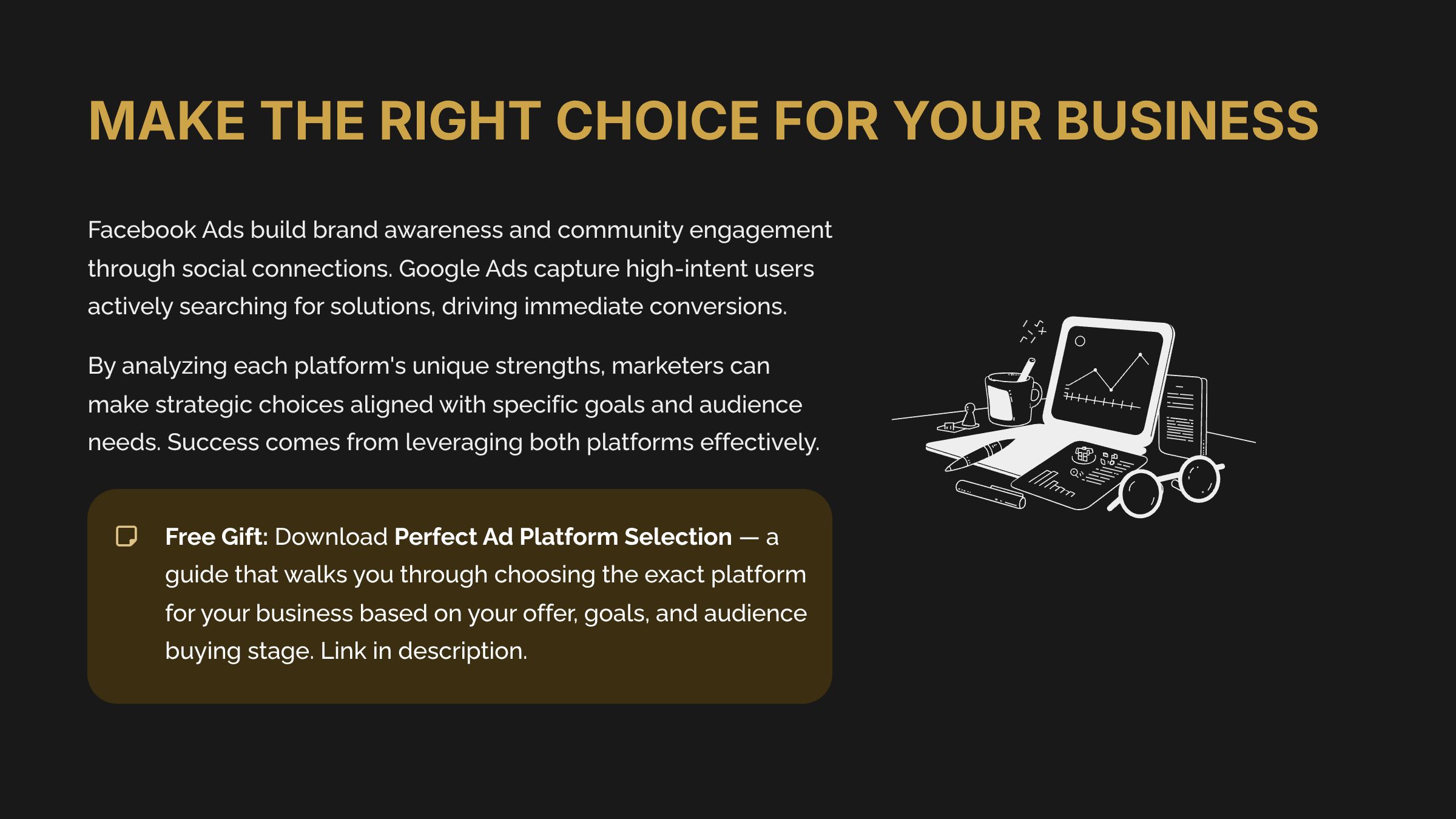
And this is exactly why I want you to grab today’s free gift, because it’s going to make your life dramatically easier. It’s called Perfect Ad Platform Selection, and it walks you through choosing the exact platform your business should be using — based on your offer, your goals, and the buying stage of your audience. Instead of feeling confused, you’ll feel confident. Instead of guessing, you’ll know exactly what to do next. You can download it for free using the link in the description.
By carefully analyzing the unique features and benefits of both advertising platforms, marketers can make strategic choices that align with their specific goals and audience needs. Whether focusing on brand engagement through Facebook or capturing immediate demand through Google, businesses can optimize their advertising efforts and improve ROI. Ultimately, understanding these digital advertising nuances equips marketers with the insights needed to navigate the ever-evolving landscape of online promotion effectively. As digital marketing continues to evolve, leveraging the strengths of both Facebook Ads and Google Ads will be essential for achieving sustained marketing success and adaptation in a competitive environment.
You don’t need another marketing agency making big promises. You need a partner who understands that sustainable business growth requires more than ads and content. It takes strategy, positioning, demand generation, sales enablement, automation, and customer retention—all working together in perfect sync.
6D FRAMEWORK
SERVICES
Subscribe to our newsletter
Get Smart, Actionable Growth Insights—Straight to Your Inbox. Proven strategies, expert tips, and real-world case studies to help you scale with clarity and control. No fluff. No spam. Just growth-focused insights you can actually use.